Beverly Hills · Rodeo Drive
Luxury Retail Photography in Beverly Hills, at the Only Frank Lloyd Wright Building on Rodeo Drive
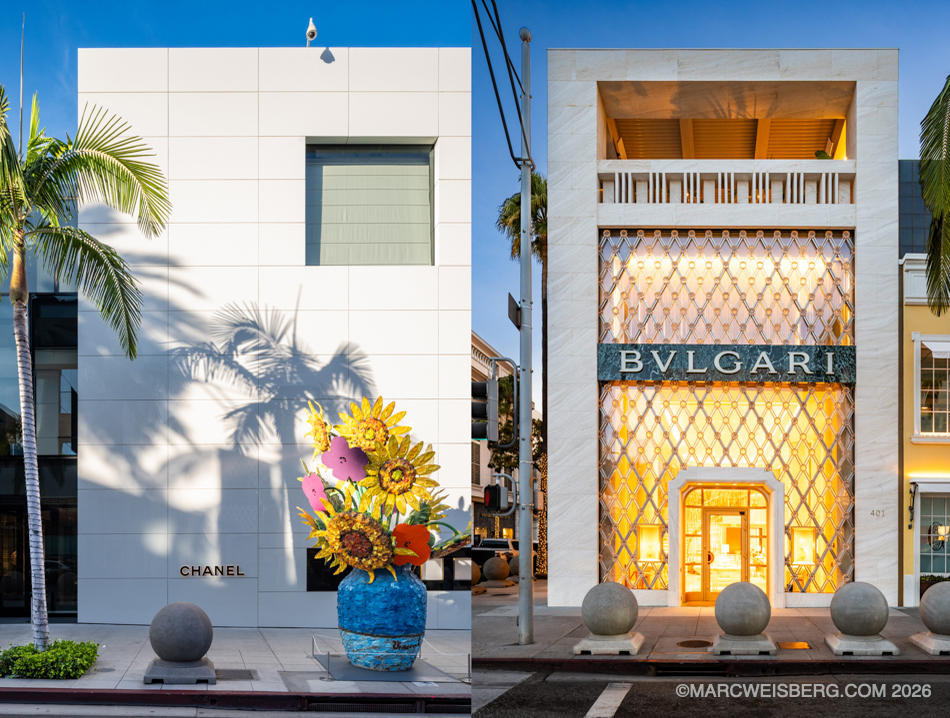
Chanel and Bulgari storefronts on N. Rodeo Drive, Beverly Hills, luxury retail photography by Marc Weisberg
Book a Complimentary 10-Minute Commercial Photography Consultation
Marc will learn about your property and recommend the best approach during your 10-minute consultation.
Rodeo Drive
One Building That Breaks the Line
Rodeo Drive is a canyon of flat facades. Four story boxes of glass and stone, each one impeccable, each one built to say the same thing in a slightly different accent. Walk the block and the buildings blur.
One of them does not.
Set back from the sidewalk, barely fifty feet wide, is a white plaster wedge with a spire on top. Frank Lloyd Wright designed the Anderton Court Shops in 1952. It is the last building he put on the ground in Los Angeles County and the only retail building he built in Southern California. It has been on the National Register of Historic Places since 2004. Several million people a year walk past it on their way to somewhere more expensive.
Marc photographed it, along with the flagship storefronts that share the corridor.
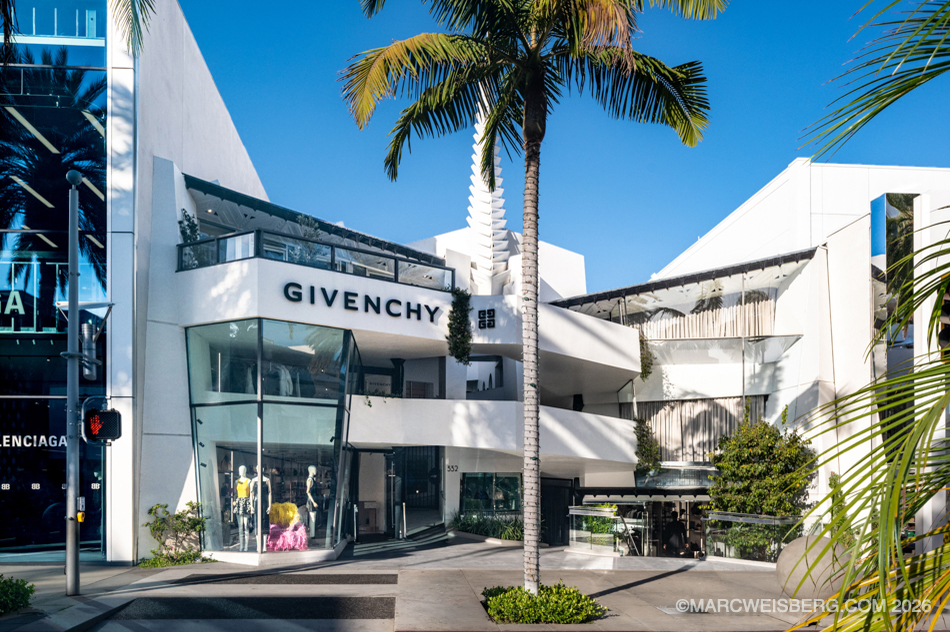
Frank Lloyd Wright, Anderton Court Shops at 332 N. Rodeo Drive, luxury retail photography by Marc Weisberg
Selected Clients
Trusted by Leading Brands, Owners and Developers
CBRE
Los Angeles commercial assets
JLL
Brokerage assignments
Westfield Century City
Retail and mixed use, Los Angeles
New York Life
Los Angeles offices
Irvine Company
Apartment homes, office space and retail
Greystar
Commercial residential and multi-family
Rexford Industrial
Southern California’s market-leading industrial REIT
Cushman & Wakefield
Commercial brokerage assignments
Lennar
National homebuilder
Clune Construction
Commercial construction and interiors
Charles Schwab
Commercial client
The Architecture
What the Building Does
Wright shaped the front elevation as an inverted V, which was a practical decision before it was a sculptural one. Rodeo Drive lots are narrow and frontage is the whole game on a retail street. Angling the glass gave every shop a piece of the sidewalk on a parcel too small to give any of them much. The geometry is not decoration. It is a retail solution rendered in plaster.
Behind that facade the building organizes itself around a hexagonal light well, with an angular ramp climbing around it and shops staggered a half floor apart on either side. There is no lobby, no elevator core, no corridor. You do not walk past this building. You walk up through it, and every shop gets seen on the way.
The spire on top does the work a sign would do on any other building, without being a sign. Givenchy occupies it today, which is its own kind of proof. A 1952 building fifty feet wide still draws a flagship luxury brand to the most expensive retail street in the country. That is 1952 thinking about a problem the rest of the street solved decades later by simply buying more frontage.
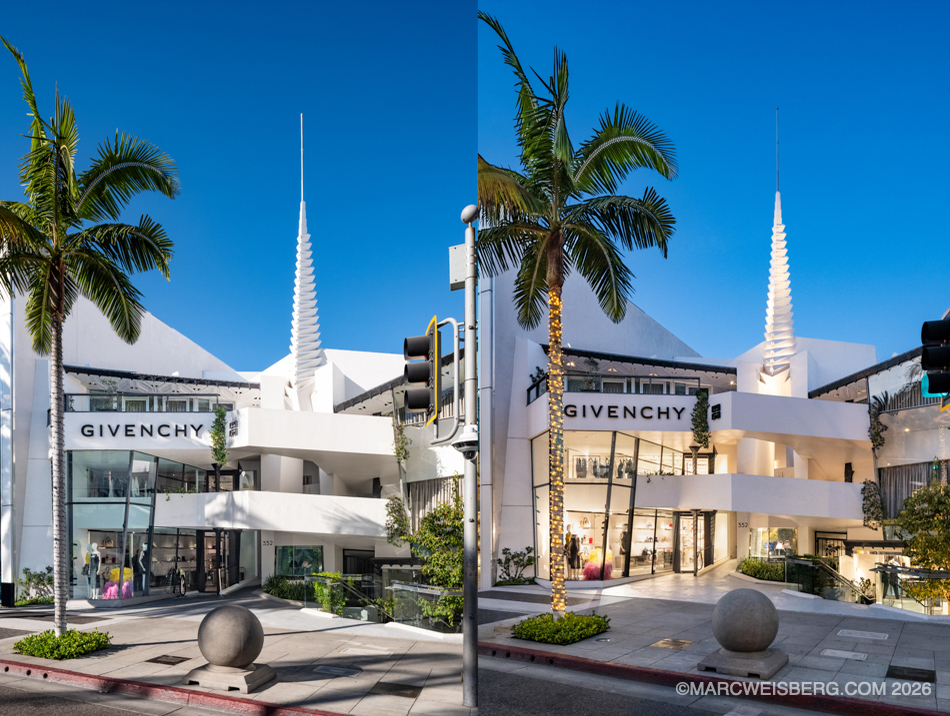
Frank Lloyd Wright, daytime & twilight, Anderton Court Shops at 332 N. Rodeo Drive, Beverly Hills. Luxury retail photography by Marc Weisberg
“A landmark does not photograph itself. Every choice Wright made on that facade is an argument, and my job is to make the argument legible in a single frame.”
The Problem Set
Four Problems That Compound
Every building presents a specific problem. This one presents four, and they compound.
There is nowhere to stand. Rodeo Drive is narrow and the building is hemmed on both sides by taller, flatter neighbors. There is no position across the street that lets a normal lens hold the full facade without tilting the camera up, and the moment the camera tilts, the verticals converge and a National Register landmark starts to look like a snapshot taken on the way to lunch. Converging verticals are the fastest way to tell a sophisticated audience that nobody thought about the photograph. Marc built the frontage frames with tilt shift optics, a 24mm and a 17mm adapted to a Leica SL2-S, from positions mapped in advance, so the building stands straight in the frame the way it stands on the street.
Most architectural photographers do not work this way. The common approach is a wide angle lens and a correction pulled in afterward. Years ago a prominent architectural photographer taught Marc tilt shift, and it changed how he sees both exteriors and interiors. You are not fixing the building later. You are getting it right in camera, and the difference shows most on a facade that is nothing but straight lines and angles.
A flat frontal frame kills it. Shoot this building straight on and the staggered half floors, the ramp, and the angled glass collapse into visual noise. The inverted V only reads as intent from an oblique. Move a few feet and the whole thing resolves. Move a few feet further and it flattens again. Finding that specific angle, and finding it from a position that is legal to stand on and clear of parked cars, is most of the work. The rest is waiting for it to be empty for eight seconds.
White plaster and midday sun do not negotiate. The facade goes to blown highlight and dead shadow under a high sun, and the detail in the tapering piers and the fascia disappears into paper white. There is no recovering it later. Marc covered it twice, in daylight and again at twilight, and the twilight frames are the hero frames. The building takes on a completely different character once the interior lighting comes up to meet a deep blue sky and the spire separates cleanly instead of dissolving into it. That is the same reason twilight photography earns its place on buildings where the exterior carries the story.
It is a working retail block. Valet traffic, delivery windows, foot traffic, security, and the operating hours of every shop on the street. Nobody is closing Rodeo Drive for a photographer. The shoot ran to the street’s clock, not Marc’s, and it stayed exterior throughout so the shops were never disturbed.
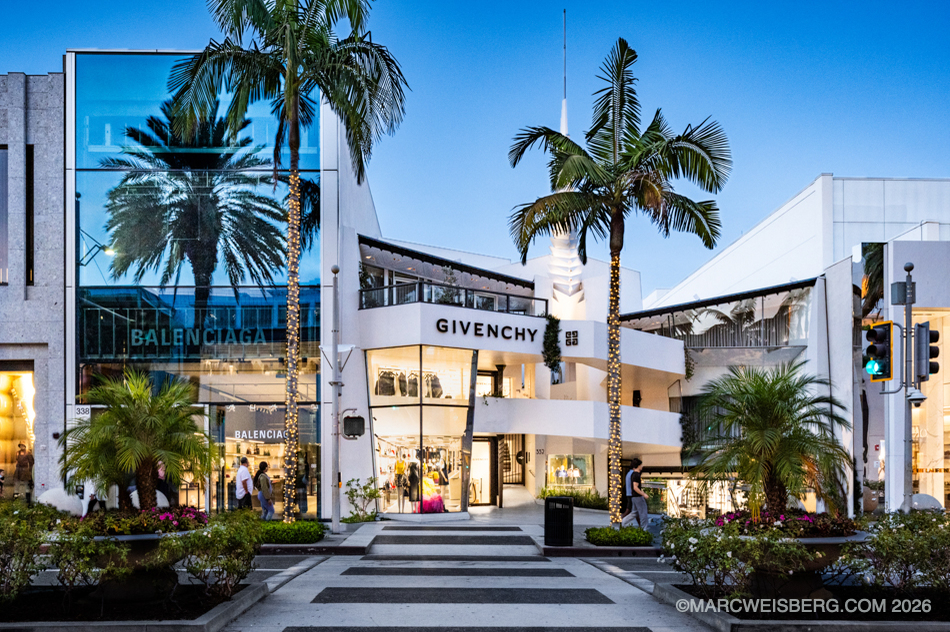
Frank Lloyd Wright, Anderton Court Shops at 332 N Rodeo Drive, luxury retail photography by Marc Weisberg
The Plan
The Plan Comes Before the Frame
None of the above gets solved on the day. It gets solved before the day.
Every architectural commission here starts with a written treatment, and on a building like this the treatment is most of the value. Camera positions get mapped and vetted in advance, each one checked for a clean foreground, for sightlines that are not blocked by a valet stand or a delivery van, and for whether the position stands on ground Marc is legally entitled to stand on. Public right of way boundaries on a corridor like this are not obvious and they are not negotiable.
The light gets calculated, not hoped for. Sunset time, the length of the usable twilight window, and the order the frames have to be captured in to fit inside it. Twilight on a facade like this is roughly a twenty to thirty minute band where the exposure balance holds. You do not get to reshoot the ones you ran out of time for. You sequence them so the hero frame lands in the middle of the window and the secondary angles bracket it.
Contingency gets built in the same way. Weather, street activity, a shop that decides today is the day for a window install. The plan absorbs it or the plan was not a plan.
By the time Marc is standing on Rodeo Drive with a camera, the decisions are already made. What happens on the day is execution.
The Corridor
The Corridor Is Part of the Story
The same engagement covered the anchor properties on the surrounding blocks. Louis Vuitton. The new Dior flagship. Chanel. Bulgari. The Beverly Wilshire.
That is not name collecting. On a street like this, the neighbors are part of the address. Rodeo Drive means what it means because of who stands on it. Imagery that shows a building alone, floating free of its block, leaves out the single most important thing about it. The same is true of luxury real estate photography in Beverly Hills, where the address carries as much weight as the property.
Context frames are not filler. They show the company a building keeps.
This is the part most commercial real estate photography gets wrong, and it is not a craft failure. It is a framing failure in the other sense of the word. The brief said photograph the building, so the building got photographed, and the story has to argue for the location with a paragraph of text and a map instead of one frame that settles it.
“On a street like this, the block is part of the building’s story. If Chanel and Louis Vuitton are the neighbors, that belongs in the imagery, not in a footnote.”
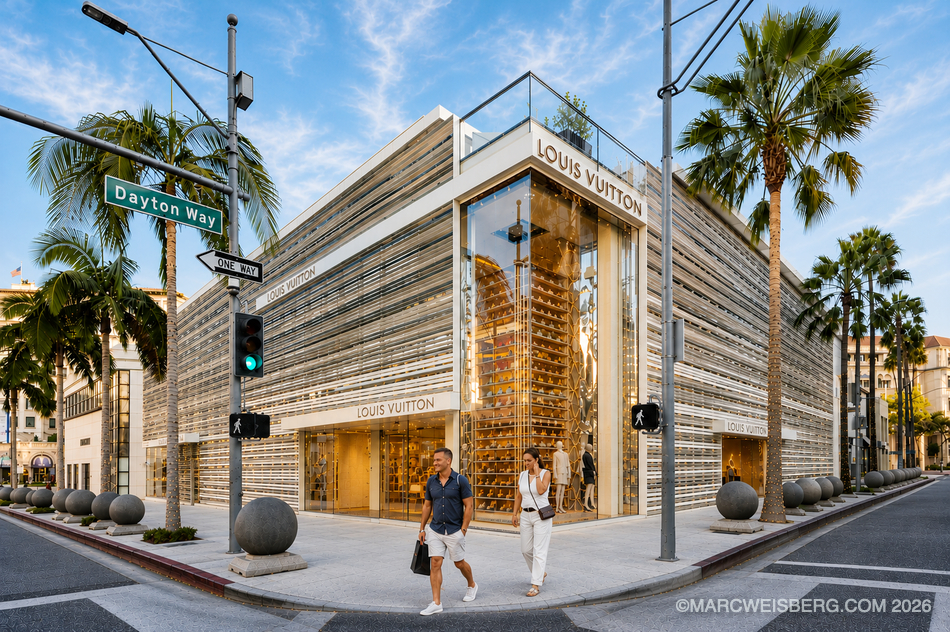
Louis Vuitton, N. Rodeo Drive, Beverly Hills, luxury retail photography by Marc Weisberg
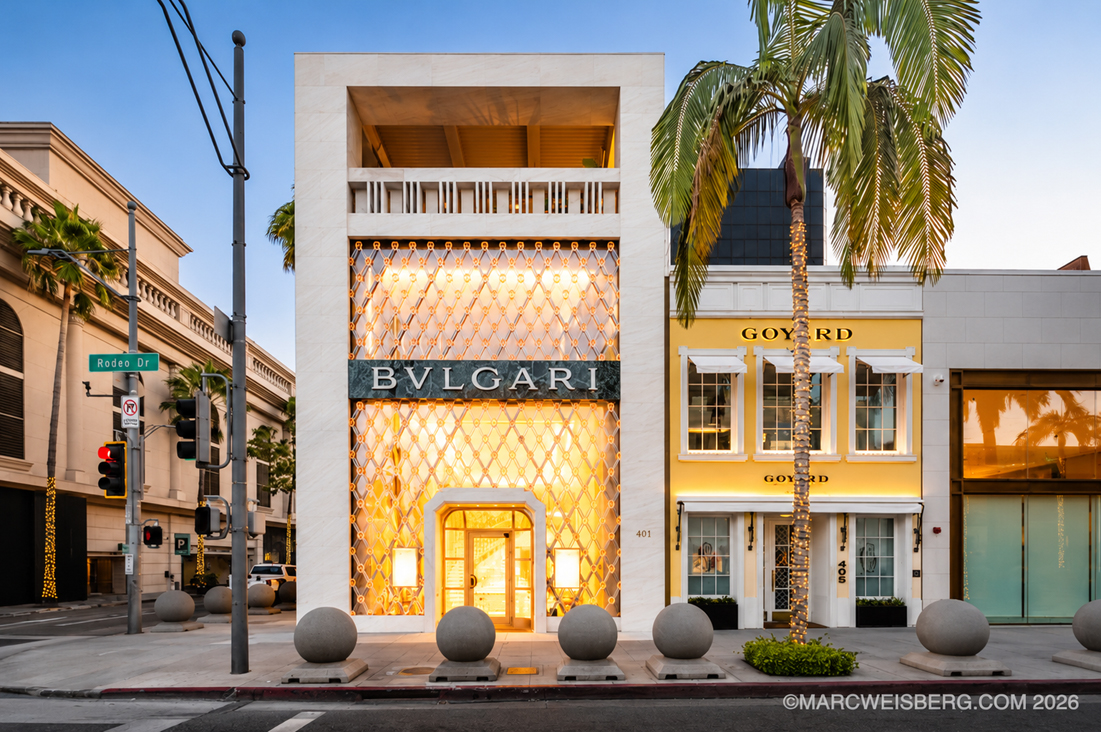
Bulgari twilight, N. Rodeo Drive, Beverly Hills, luxury retail photography by Marc Weisberg
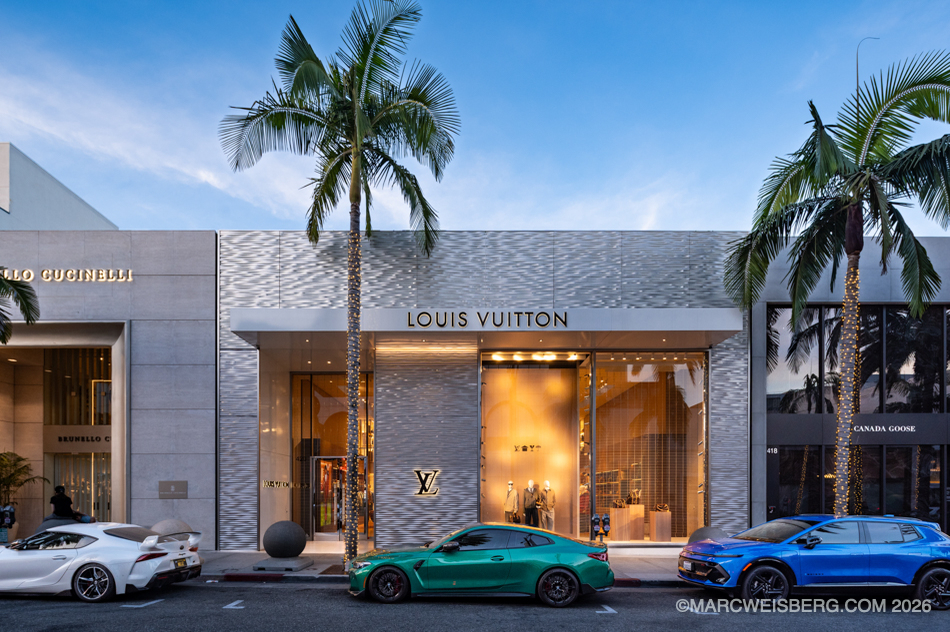
Louis Vuitton, N. Rodeo Drive, Beverly Hills, luxury retail photography by Marc Weisberg
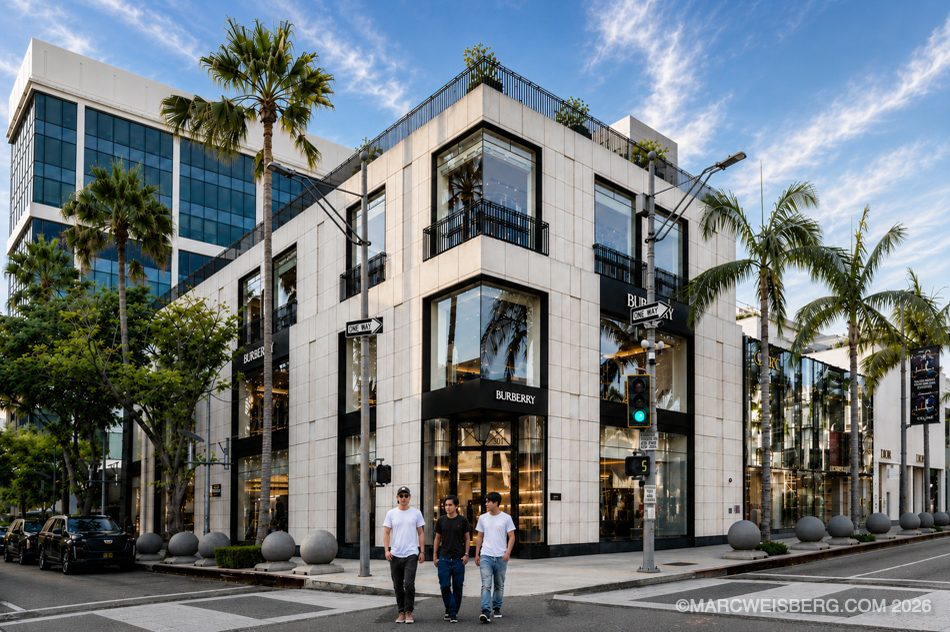
Burberry, N. Rodeo Drive, Beverly Hills, luxury retail photography by Marc Weisberg
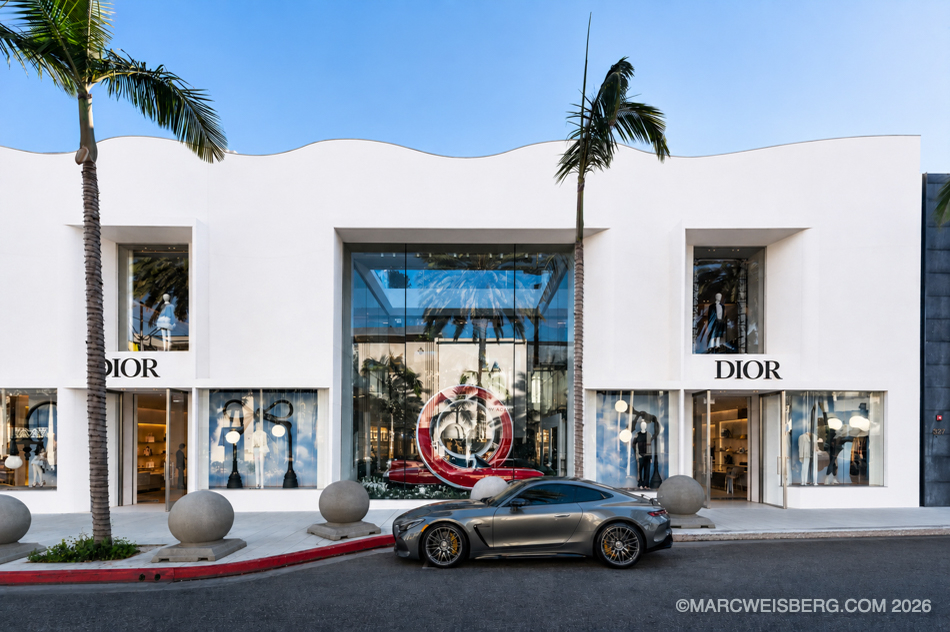
Dior, N. Rodeo Drive, Beverly Hills, luxury retail photography by Marc Weisberg
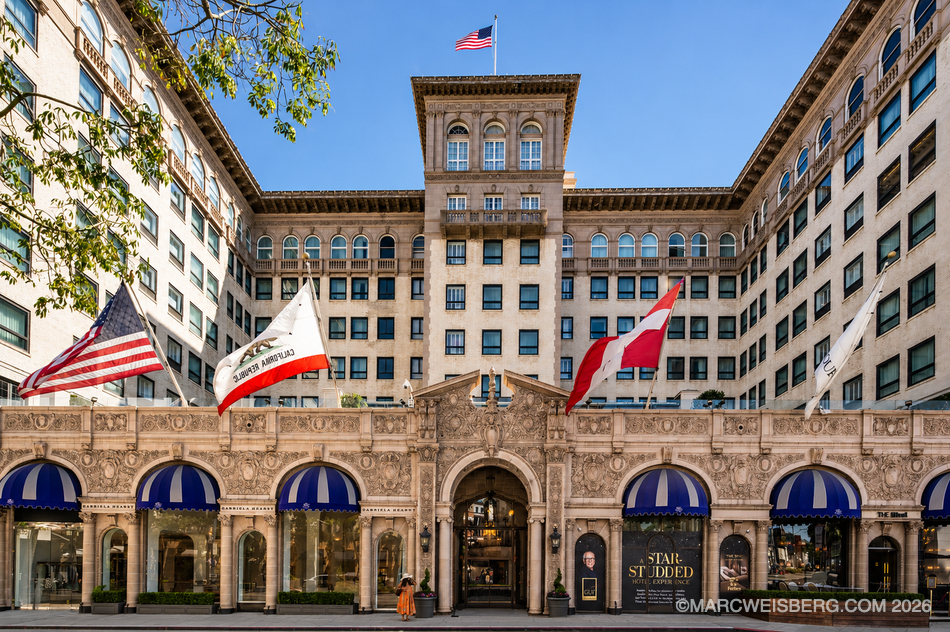
The Beverly Wilshire, a Four Seasons Hotel, Beverly Hills, luxury hospitality photography by Marc Weisberg
Provenance
Why a Landmark Is Different
Most retail buildings are defined by the brands inside them. A handful are defined by something harder to replace: provenance, scarcity, a name on the drawings that cannot be replicated at any budget.
There is exactly one Frank Lloyd Wright building on Rodeo Drive, and there will never be another. That fact does not show up in a storefront window. It shows up in the imagery or it does not show up at all.
That is what 26 years of architectural and commercial work teaches. The frame is not the deliverable. What the frame helps people see is the deliverable.
“Nobody buys a photograph. They buy the confidence to make a decision, and the photograph is what gets them there.”
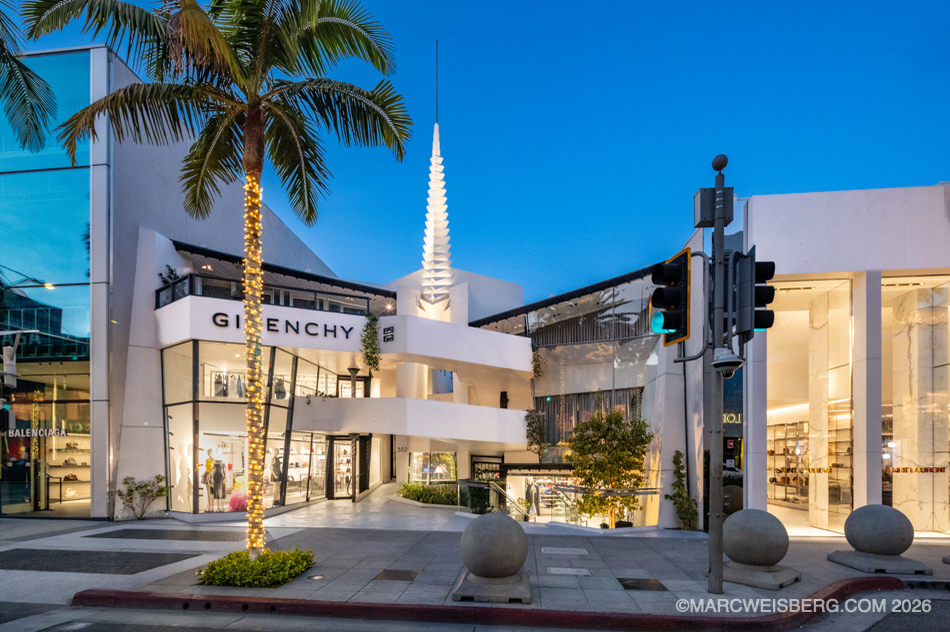
Frank Lloyd Wright, twilight, Anderton Court Shops at 332 N. Rodeo Drive, luxury retail photography by Marc Weisberg
How Marc Works
Treatment. Production. Delivery.
Every project runs the same three phases. The plan gets written before the first frame, the plan gets executed, and the files arrive ready to work. See the portfolio for how that looks across properties.
01Treatment
The plan is written before the first frame: camera positions, sightlines, light and the order of every shot.
02Production
The plan is executed on location, on the street’s clock, without disturbing the shops.
03Delivery
Files arrive sized for print, large screens, websites and the press.
Book a Complimentary 10-Minute Commercial Photography Consultation
Questions
Frequently Asked Questions
Who photographs landmark and historic commercial buildings in Beverly Hills?+
Marc Weisberg is an Orange County and Los Angeles based architectural photographer with over 26 years of experience photographing landmark, historic, and luxury retail property for owners, developers, brokers, and brands throughout Southern California, including Beverly Hills and the Rodeo Drive retail corridor.
Why does a historic building need a different photographic approach?+
Provenance is value you cannot see in a storefront window. A landmark facade has to be photographed so the design intent is legible to someone who is not an architect. That means controlled verticals, an oblique that reveals the geometry, and light that holds detail in the facade rather than blowing it out.
Should luxury retail photography include the neighboring storefronts?+
Yes. On a street like Rodeo Drive the neighboring flagships are part of the building’s story. Context frames show the street a building belongs to, so the location never has to be explained in text alone.
What is delivered for a luxury retail photography project?+
Every project runs in three phases: a written treatment before the shoot, production on site, and delivery of files sized to hold up full bleed in print, on a large screen and in the press.
Who uses this kind of photography?+
Luxury retail brands, property owners, developers, brokers, architects, and the marketing teams who present landmark and flagship retail buildings in print, online, and in the press.
Areas Served
Landmark and luxury retail across Southern California
Marc photographs landmark, commercial and luxury retail properties on location. Services are available nationwide for select projects.
Los Angeles
Beverly Hills · Century City · West Hollywood · Santa Monica · Culver City · Downtown Los Angeles · Pasadena
Orange County
Irvine · Newport Beach · Costa Mesa · Laguna Beach · Huntington Beach · Dana Point
San Diego
San Diego · La Jolla · Carlsbad
What Clients Are Saying
Real Client Experiences
★★★★★
“Thrilled is a perfect adjective to describe how we feel about your photography. Across a ten property portfolio, your work consistently stands out. Good content with good weather always helps, but the different vantage points, ground level, drone and aerial, along with images taken at different times of day, is a real differentiator.”
Kurt Altvater
Senior Vice President, Capital Markets, CBRE
★★★★★
“Marc is a consummate professional photographer. He always meets our deadlines and exceeds expectations. His attention to detail and open communication provides us with confidence that we have elected the right photographer for every assignment.”
Tanya von Marschner
Executive Marketing Broker, HFF
★★★★★
“Marc is an exceptional architectural photographer. He has a strong ability to understand a project’s intent and translate it into clean, compelling imagery that elevates the asset. His attention to detail, professionalism on site, and consistency across large projects make him a go-to partner for architectural and commercial work. Highly recommended for anyone looking to present their properties at a high level.”
Terence Truong
Production Manager, IG1 Communications
★★★★★
“We have worked with Marc on commercial photo shoots, and he always maintains a sense of professionalism within our client spaces. He is very responsive with our various scheduling needs. Marc’s images are top-notch. Highly recommended.”
Alison Kermode
Clune Construction Company
★★★★★
“These are incredible. Our marketing team actually used the word ‘incredible.’ We are super excited to get these out there and get some tenants in this space.”
Rexford Industrial Properties
Commercial Real Estate
★★★★★
“Marc Weisberg has photographed over fifty interior remodeling projects for Sea Pointe Home Design and Construction across Orange County, and his real estate photography is at a level you rarely see outside of national design publications. His experience shooting luxury real estate photography for top Orange County agents shows in every frame, from the lighting to the angles to the finished detail. We recommend Marc without hesitation to any contractor, designer, or agent in Southern California.”
Sea Pointe Home Design & Construction
Interior Remodeling & Construction
Orange County · Los Angeles · San Diego
Have a landmark or flagship property? Let’s talk.
Magazine quality photography for landmark buildings, flagship retail and the streets they stand on.
Your 10-minute consultation is complimentary. Your image is everything.
Book a Complimentary 10-Minute Commercial Photography Consultation
Marc Weisberg is an Orange County-based architectural photographer with over 26 years of experience serving luxury residential, commercial, and multi-family clients throughout Southern California. A Sony Artisan of Imagery from 2015 to 2021, Marc’s work has been published in over a dozen books and featured by Adobe, Sony USA, Christie’s International Realty, CBRE, Irvine Company, Cushman and Wakefield, Clune Construction, Berkshire Hathaway, and Rexford Industrial. Commissions range from $5 million luxury estates to $1 billion commercial developments across Orange County, Los Angeles, and San Diego.